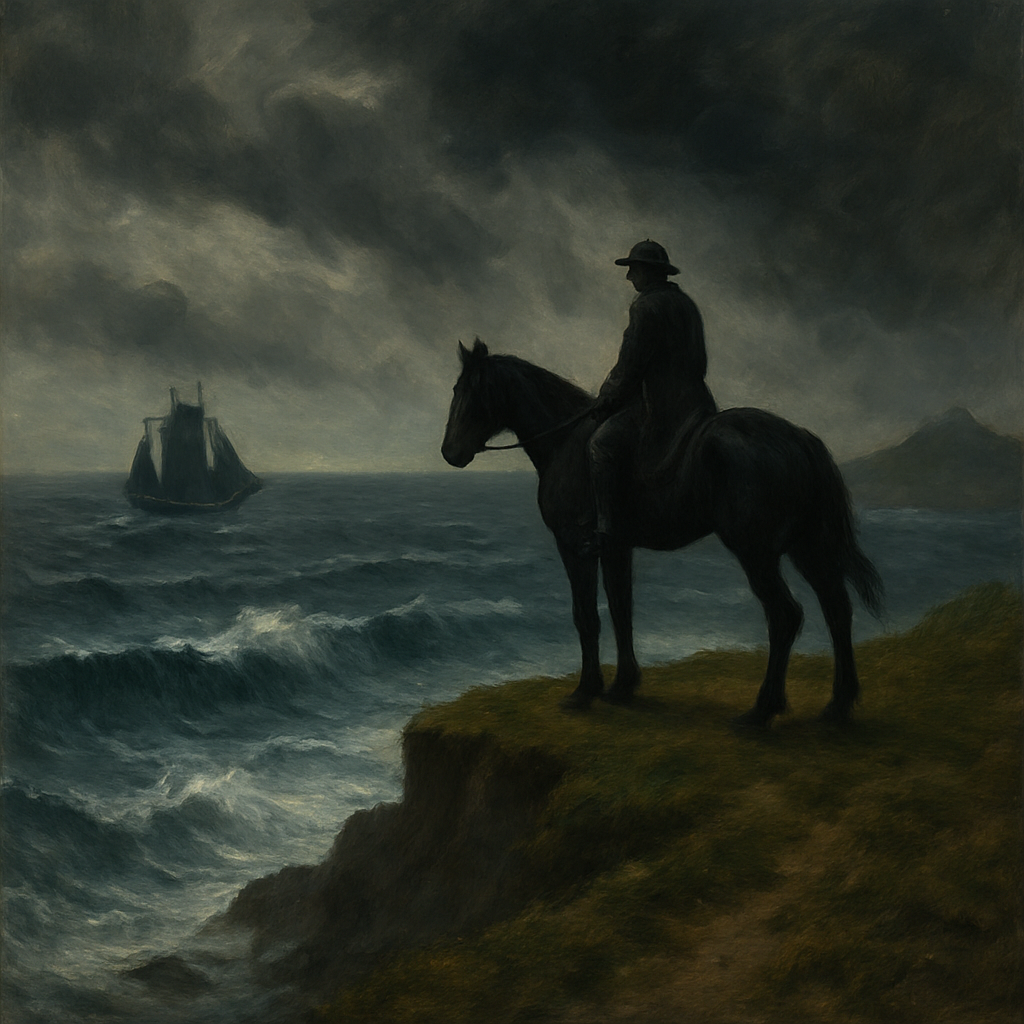
Section 1: Plot & Setting (1–25)
- Where is Riders to the Sea set?
Answer: Aran Islands, Ireland
2. Who are the first characters introduced in the play?
Answer: Nora and Cathleen
What item does Nora secretly bring home at the beginning?
Answer: A bundle of clothes
Who is believed to have drowned before the play begins?
Answer: Michael
What natural element dominates the play?
Answer: The sea
What is Bartley preparing for when the play begins?
Answer: A journey to the mainland to sell horses
How many sons had Maurya lost before Bartley leaves?
Answer: Five
Why does Maurya fear for Bartley’s safety?
Answer: She believes the sea will take him too
What action does Maurya regret?
Answer: Not blessing Bartley before he left
How is Michael’s death confirmed?
Answer: Through identification of clothes by the priest
Who delivers the news of Bartley’s death?
Answer: Villagers
How does Bartley die?
Answer: He is thrown into the sea by his horse
What emotion dominates the ending of the play?
Answer: Resigned sorrow
What happens to all of Maurya’s sons by the end?
Answer: All have died at sea
How many acts does the play contain?
Answer: One
What is the time span of the play’s action?
Answer: A few hours
Where does most of the play’s action occur?
Answer: Inside Maurya’s cottage
Why is the priest mentioned in the play?
Answer: He helps confirm Michael’s identity
What object does Maurya carry to Bartley when he leaves?
Answer: A loaf of bread and her blessings
What does the sea symbolically represent in the play?
Answer: Fate and uncontrollable nature
What event marks the climax of the play?
Answer: News of Bartley’s death
Why do the daughters hide Michael’s clothes from Maurya?
Answer: To protect her from more grief
What is the final line of the play associated with?
Answer: Peace after complete loss
What is the mood of the play’s beginning?
Answer: Anxious and tense
What cultural practice is depicted through the mourning?
Answer: Irish rural traditions of grief and loss
Section 2: Character-Based MCQ (26–50)
Who is the tragic protagonist of the play?
Answer: Maurya
What is Bartley’s role in the family?
Answer: The last surviving son
How is Cathleen characterized?
Answer: Mature and responsible
Who is Nora in relation to Maurya?
Answer: Her youngest daughter
How does Maurya react after Bartley’s death?
Answer: She surrenders to fate peacefully
Which character shows the most concern about hiding grief?
Answer: Cathleen
What does Bartley represent thematically?
Answer: The last hope of the family
Which character speaks the final words of the play?
Answer: Maurya
What emotion does Nora mostly represent?
Answer: Innocence and concern
How is Michael described throughout the play?
Answer: Lost and mourned
Who takes initiative to confirm Michael’s identity?
Answer: Nora
Who tries to act strong to hold the family together?
Answer: Cathleen
Which character makes the decision to go to the mainland despite warnings?
Answer: Bartley
Who is the most religiously resigned character?
Answer: Maurya
Which character receives Maurya’s late blessing?
Answer: Bartley
How many sons does Maurya lose in her lifetime?
Answer: Six
What role does the priest play in the background?
Answer: Confirms Michael’s identity and gives spiritual advice
Who demonstrates the most practical thinking?
Answer: Cathleen
Which character insists on selling horses for survival?
Answer: Bartley
Who is symbolically the “rider to the sea”?
Answer: Bartley
Which daughter is more emotional in expression?
Answer: Nora
Who delivers the news of Bartley’s death to the family?
Answer: A villager (off-stage messenger)
What does Maurya symbolize in Irish rural drama?
Answer: The archetype of the grieving mother
Which character displays foresight and intuition?
Answer: Maurya
Which of the daughters tries to suppress Maurya’s fears?
Answer: Cathleen
Section 3: Theme & Symbolism MCQ (51–75)
What is the central theme of Riders to the Sea?
Answer: Human helplessness before nature
The sea symbolizes:
Answer: Fate and death
What does Bartley’s white horse symbolize?
Answer: Death approaching
What universal human condition does the play explore?
Answer: Suffering and loss
The repeated deaths in the play highlight:
Answer: The inevitability of fate
Which theme is NOT present in the play?
(a) Religion • (b) Greed • (c) Loss • (d) Fate
Answer: (b) Greed
The family’s livelihood being tied to the sea represents:
Answer: Dependence on nature despite its dangers
Maurya’s final speech reflects:
Answer: Spiritual resignation
The women in the play symbolize:
Answer: Silent strength and endurance
The horse and the sea together represent:
Answer: Agents of destiny
The bundle of clothes is symbolic of:
Answer: Death confirmation and grief
The theme of death in the play is mostly:
Answer: Unseen but ever-present
How does the sea reflect Irish identity in the play?
Answer: As a life-giver and life-taker
What does Maurya symbolize?
Answer: The suffering Irish mother figure
The theme of isolation is shown through:
Answer: The island setting and emotional suffering
What does the cottage setting reinforce?
Answer: Claustrophobic grief and containment
Which symbol best captures final peace?
Answer: Maurya’s acceptance
What role does religion play in the narrative?
Answer: Comfort and resignation to divine will
How is nature portrayed in the play?
Answer: Indifferent and overpowering
The young girls’ actions reflect:
Answer: Hope and survival instinct
Bartley’s journey signifies:
Answer: A final step toward fate
The mourning practices in the play represent:
Answer: Irish rural traditions and spirituality
The cycle of loss in the play emphasizes:
Answer: The unending suffering of the poor
Which of these is a recurring motif?
(a) Bells • (b) Sea waves • (c) Firelight • (d) Rain
Answer: (b) Sea waves
The absence of male voices in the play underscores:
Answer: Women’s emotional burden and endurance
Section 4: Language & Literary Devices MCQ (76–100)
What type of English dialect is used in the dialogue?
Answer: Hiberno‑English with Irish idiom
Which device is seen in the phrase “blind destroyer the sea”?
Answer: Personification
What language quality is dominant in the play?
Answer: Poetic realism
What literary device involves repetition of sounds at line endings?
(a) Alliteration • (b) Rhyme • (c) Assonance • (d) Onomatopoeia
Answer: (b) Rhyme
The recurring sea-wind sound effect is an example of:
Answer: Onomatopoeia
Synge’s dialogue often includes time-related images like “dark day”—this is an example of:
Answer: Imagery
What does the motif of clothing emphasize?
Answer: Memory and identification of the dead
The play’s tone is mostly:
Answer: Solemn and elegiac
Synge’s use of simple, unaffected word choice demonstrates:
Answer: Vernacular speech for realism
What rhetorical method appears when Maurya recalls her lost sons one by one?
Answer: Anaphora (repetition at beginning of phrases)
The sea-related metaphors contribute to:
Answer: The thematic unity of natural force
What style is the play written in?
Answer: A one-act verse drama with poetic dialogue
The dialogue is rich in emotional understatement rather than dramatic outbursts—this is an example of:
Answer: Understatement
What contrasts with the grief in the play?
Answer: The everyday domestic tasks (preparing food, clothes, etc.)
Which device is used in: “We’ll pray for them — all of them”?
Answer: Inclusive pronoun for communal voice
Synge’s narrative voice is suffused with:
Answer: Spare elegance and restraint
The motif of seaweed or kelp frequently evokes:
Answer: Desolation and harsh island life
The play lacks formal chorus, but the waves act as:
Answer: Unseen chorus suggesting emotional rhythm
The symbolic use of light and dark imagery reflects:
Answer: Shadow of grief and the absence of hope
What kind of irony is present when Maurya blesses Bartley after his death?
Answer: Tragic irony
The play’s single-act structure intensifies:
Answer: Emotional focus and pacing
Which literary device underscores inevitability?
Answer: Foreshadowing (e.g. early fears announced)
Synge’s language reveals the influence of which tradition?
Answer: Irish oral tradition and folklore
The phrase “They are all gone now” repeats to build rhythm—this is:
Answer: Repetition
The dramatization of silence and silence between speech highlights:
Answer: Emotional depth and unspoken grief
Section 5: Important Quotations MCQ (101–125)
“No man at all can be living forever…” – Who says this?
Answer: Maurya
The quote “They’re all gone now, and there isn’t anything more the sea can do to me” reflects:
Answer: Acceptance of fate
“It’s hard set we’ll be surely the day you’re drowned…” – This shows:
Answer: Foreshadowing of Bartley’s death
Who says: “Isn’t it sorrow enough is on everyone in this house?”
Answer: Cathleen
The line “I seen the fearfulest thing” is uttered by:
Answer: Maurya
What does the phrase “a star up against the moon” symbolize?
Answer: Ominous sign of death
“He’s gone now, and when the black night is falling I’ll have no son left me” expresses:
Answer: Maurya’s ultimate grief
“She’s seen the frightfulest thing any person has seen” – refers to:
Answer: Maurya witnessing Bartley’s fate
Who says: “The blessing of God on you” too late?
Answer: Maurya (to Bartley)
What does Maurya mean when she says: “There isn’t anything more the sea can do to me”?
Answer: She has lost everything
“The salt is gone now, and the basket of meal is gone…” – What does this signify?
Answer: Loss of basic necessities along with life
“I’ll have no call now to be waking and crying in the night” – This reflects:
Answer: Inner peace through acceptance
“I’ve had a husband and a father, and six sons in this house…” – illustrates:
Answer: Maurya’s history of loss
The use of repeated lamenting phrases adds to:
Answer: The lyrical and tragic tone
“He’s gone now, and I’ll have no son left me…” – identifies which recurring theme?
Answer: Loss and maternal sorrow
“We ought to have made him a fine coffin out of the white boards” – Who says this?
Answer: Cathleen
The quote about “nailing the boards together” indicates:
Answer: Ritualistic mourning and burial customs
“It’s the life of a young man to be going on the sea” – represents:
Answer: Acceptance of occupational risks
“There’s a star up against the moon…” foreshadows:
Answer: Death of Bartley
“You’ve had the white boards… it’s a great rest…” – Symbolizes:
Answer: Peace through death
“I’ll be having peace forever” – who says this?
Answer: Maurya
The use of Biblical tone in Maurya’s speech adds a sense of:
Answer: Sacred mourning
“Michael has a clean burial in the far north…” – shows:
Answer: Spiritual closure
Which character uses poetic expressions to express grief?
Answer: Maurya
The repetition of “gone” and “peace” highlights:
Answer: Final acceptance and thematic closure
Section 6: Mixed & Higher-Order MCQ (126–150)
Which of the following best summarizes the core tragedy of the play?
(a) Economic poverty • (b) Loss of faith • (c) Repeated loss and helplessness • (d) Family conflict
Answer: (c) Repeated loss and helplessness
The dramatic technique of unity of time and place in the play enhances:
Answer: Emotional intensity and realism
Why is Riders to the Sea often considered a modern tragedy?
Answer: It portrays everyday people facing universal fate
How is the island setting crucial to the plot?
Answer: It isolates the characters and heightens the sense of entrapment
Which character is the moral and emotional anchor of the play?
Answer: Maurya
Why does Synge not show the deaths onstage?
Answer: To emphasize psychological impact over physical action
How does Cathleen contrast with Maurya?
Answer: She is more practical and hopeful
What makes the sea a character in itself?
Answer: Its constant presence and power over the plot
The play ends with Maurya’s:
Answer: Spiritual release
Which line best expresses the Irish acceptance of suffering?
Answer: “No man at all can be living forever”
What aspect of Irish culture is strongly depicted?
Answer: Rural beliefs, customs, and oral tradition
Which modern element does the play share with Greek tragedy?
Answer: Fate-driven plot with chorus-like rhythm
What does Bartley’s silence in the play symbolize?
Answer: Submission to fate
Which of the following best describes Synge’s writing style?
Answer: Poetic, minimal, and emotionally loaded
Why does the play still resonate with modern readers?
Answer: It deals with universal emotions like loss and grief
Maurya’s transformation is from:
Answer: Resistance to acceptance
Which word does NOT describe the tone of the play?
(a) Grief • (b) Comedy • (c) Sorrow • (d) Resignation
Answer: (b) Comedy
The sea is described as “blind” to highlight:
Answer: Its indifference to human suffering
What dramatic device is used when the audience knows Bartley will die, but characters don’t?
Answer: Dramatic irony
The tragic mood is built mainly through:
Answer: Language and rhythm of speech
What does the women’s role in the play suggest about gender?
Answer: Women bear and process emotional suffering
Why is Riders to the Sea considered timeless?
Answer: It expresses universal human loss
What poetic quality does the dialogue resemble?
Answer: Lament or keening (Irish mourning poetry)
The tragic irony lies in the fact that:
Answer: Maurya accepts fate only after complete loss
. The final mood of the play is best described as:
Answer: Calm after storm
…..
এখানে সংকলিত “Riders to the Sea” (J.M. Synge) নাটকের উপর ভিত্তি করে তৈরি 150টি MCQ সম্পূর্ণরূপে মূল টেক্সট পাঠ, বিশ্লেষণ, ও শিক্ষার্থীদের বোর্ড পরীক্ষার প্রস্তুতির উদ্দেশ্যে আমার নিজস্ব গবেষণা, অনুধাবন ও সৃজনশীল চিন্তন থেকে তৈরি।
প্রতিটি প্রশ্ন ও উত্তর নাট্যপাঠ এবং সাহিত্য বিশ্লেষণের আলোকে স্বতন্ত্রভাবে রচিত, যা এই বইয়ের স্বত্বাধিকারীর মেধাস্বত্বের অন্তর্ভুক্ত।
কোনো অংশ –
প্রশ্ন, ব্যাখ্যা, বিন্যাস বা গঠন … অনুমতি ছাড়া সম্পাদনা, পুনঃপ্রকাশ, অনলাইন বা অফলাইন মাধ্যমে বিতরণ, অথবা নিজের নামে প্রচার করা অপরাধ এবং নৈতিকতার পরিপন্থী।
স্বত্বাধিকারী:
PORASONA.oBadhyo.com
“All rights reserved”
Leave a Reply