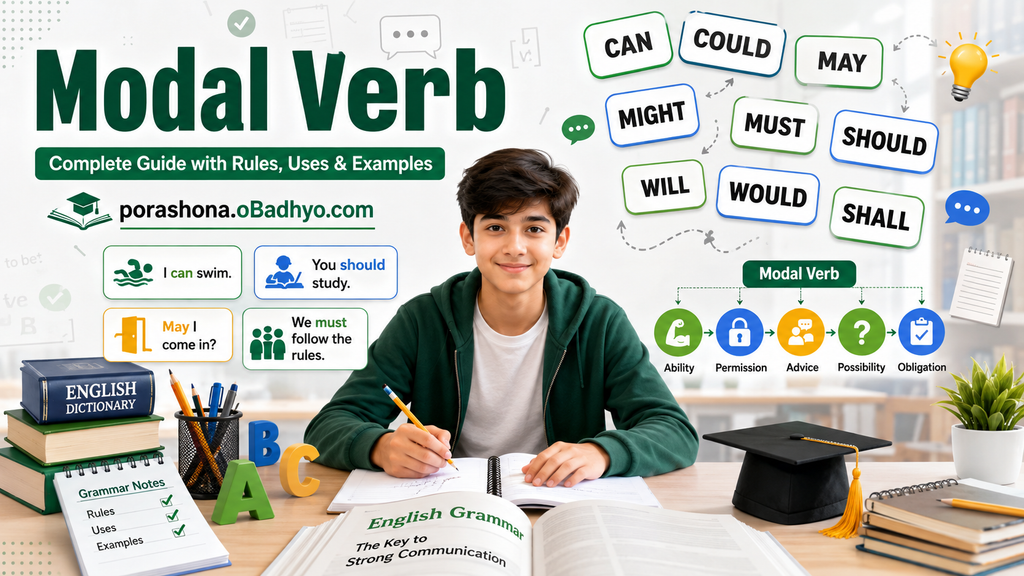
Modal Verb কী, কেন ব্যবহার করা হয়, কীভাবে চিনবেন এবং কীভাবে বাক্যে ব্যবহার করবেন—সহজ বাংলা ব্যাখ্যা, প্রচুর উদাহরণ, Grammar Rules, Exercises ও Common Mistakes সহ সম্পূর্ণ গাইড।Modal Verb কী? সহজ ভাষায় Modal Verb শেখার সম্পূর্ণ গাইড
ইংরেজি Grammar-এর এমন কিছু Topic আছে যেগুলো প্রথমে কঠিন মনে হলেও একবার বুঝে গেলে খুব সহজ লাগে। Modal Verb তার মধ্যে অন্যতম।
অনেক শিক্ষার্থী ইংরেজিতে ভালো Vocabulary জানে, Tense-ও কিছুটা পারে, কিন্তু Can, Could, May, Might, Must, Should, Will, Would—এই শব্দগুলোর সঠিক ব্যবহার জানে না। ফলে Sentence লিখতে বা Speaking করতে গিয়ে ভুল করে।
এই আর্টিকেলে আমরা Modal Verb একদম শুরু থেকে শিখব। এমনভাবে শিখব যেন আগে কখনও Modal Verb না পড়লেও পুরো বিষয়টি পরিষ্কার হয়ে যায়।
এই গাইডটি উপযোগী—
- ✅ Class 5–12
- ✅ মাধ্যমিক ও উচ্চমাধ্যমিক শিক্ষার্থী
- ✅ Competitive Exam
- ✅ Spoken English Learners
- ✅ English Grammar Beginners
তাহলে চলুন শুরু করা যাক।
Modal Verb কী?
খুব সহজ ভাষায় বললে—
Modal Verb হলো এমন একটি Helping Verb (Auxiliary Verb), যা Main Verb-এর আগে বসে সেই কাজ সম্পর্কে অতিরিক্ত অর্থ প্রকাশ করে।
এই অতিরিক্ত অর্থ হতে পারে—
- ক্ষমতা (Ability)
- অনুমতি (Permission)
- সম্ভাবনা (Possibility)
- উপদেশ (Advice)
- বাধ্যবাধকতা (Obligation)
- ইচ্ছা (Willingness)
- প্রয়োজন (Necessity)
- অনুরোধ (Request)
অর্থাৎ, Modal Verb আমাদের বলে দেয় কাজটি কীভাবে বা কোন পরিস্থিতিতে হচ্ছে।
একটি সহজ উদাহরণ
দেখুন এই দুটি বাক্য—
I play football.
আমি ফুটবল খেলি।
এখানে শুধু বলা হয়েছে আমি ফুটবল খেলি।
এখন দেখুন—
I can play football.
এখানে can যোগ হওয়ার ফলে অর্থ পরিবর্তন হয়ে গেল।
এখন বাক্যটির অর্থ—
আমি ফুটবল খেলতে পারি।
অর্থাৎ can শব্দটি কাজ করার ক্ষমতা প্রকাশ করছে।
এটাই Modal Verb-এর কাজ।
আরেকটি উদাহরণ—
You should study.
অর্থ—
তোমার পড়াশোনা করা উচিত।
এখানে should উপদেশ দিচ্ছে।
আরেকটি উদাহরণ—
You must wear a helmet.
অর্থ—
তোমার অবশ্যই হেলমেট পরা উচিত।
এখানে must বাধ্যবাধকতা প্রকাশ করছে।
Modal Verb কেন শিখব?
অনেকেই মনে করে Modal Verb শুধু পরীক্ষার জন্য দরকার। আসলে বিষয়টি তার চেয়েও গুরুত্বপূর্ণ।
Modal Verb জানলে আপনি—
✅ সুন্দরভাবে ইংরেজিতে কথা বলতে পারবেন।
✅ সঠিক Grammar ব্যবহার করতে পারবেন।
✅ Writing Skill উন্নত হবে।
✅ Speaking অনেক বেশি Natural হবে।
✅ Translation সহজ হবে।
✅ School Exam, Board Exam, Competitive Exam এবং Interview-তে ভালো করতে পারবেন।
Modal Verb ছাড়া ইংরেজি অসম্পূর্ণ
ভাবুন, আপনি শুধু বলতে পারেন—
I go.
কিন্তু আপনি যদি বলতে চান—
- আমি যেতে পারি।
- আমি যেতে চাই।
- আমাকে যেতে হবে।
- আমার যাওয়া উচিত।
- আমি হয়তো যাব।
তাহলে শুধু go দিয়ে হবে না।
এগুলোর জন্য দরকার—
- can
- will
- should
- must
- may
- might
এই কারণেই Modal Verb ইংরেজির অত্যন্ত গুরুত্বপূর্ণ অংশ।
Modal Verb-এর প্রধান কাজ
Modal Verb সাধারণত নিচের বিষয়গুলো প্রকাশ করে।
| ব্যবহার | অর্থ | উদাহরণ |
|---|---|---|
| Ability | ক্ষমতা | I can swim. |
| Permission | অনুমতি | May I come in? |
| Advice | উপদেশ | You should exercise. |
| Necessity | প্রয়োজন | You must study. |
| Obligation | বাধ্যবাধকতা | Students must wear uniforms. |
| Possibility | সম্ভাবনা | It might rain today. |
| Request | অনুরোধ | Could you help me? |
| Offer | প্রস্তাব | Shall I help you? |
| Future | ভবিষ্যৎ | I will call you. |
Modal Verb-এর সম্পূর্ণ তালিকা
ইংরেজিতে সবচেয়ে বেশি ব্যবহৃত Modal Verb হলো—
| Modal Verb | বাংলা অর্থ |
|---|---|
| Can | পারা |
| Could | পারত / পারবেন কি? |
| May | অনুমতি / হতে পারে |
| Might | হতে পারে |
| Must | অবশ্যই |
| Shall | করব / চলুন |
| Should | উচিত |
| Will | করব |
| Would | করতাম / করবেন কি? |
| Need (Modal Use) | প্রয়োজন |
| Ought to | উচিত |
| Used to | আগে অভ্যাস ছিল |
এর মধ্যে Can, Could, May, Might, Must, Should, Will, Would সবচেয়ে বেশি ব্যবহৃত হয়।
Modal Verb কীভাবে চিনবে?
Modal Verb চেনা খুব সহজ।
যদি বাক্যে নিচের শব্দগুলোর কোনো একটি থাকে—
- can
- could
- may
- might
- must
- shall
- should
- will
- would
তাহলে সেটি Modal Verb হওয়ার সম্ভাবনা খুব বেশি।
যেমন—
She can dance.
We should respect our parents.
You must follow the rules.
May I come in?
Modal Verb মনে রাখার সহজ কৌশল
একটি বিষয় সবসময় মনে রাখুন—
Modal Verb নিজে কোনো কাজ করে না।
এটি শুধু Main Verb-কে সাহায্য করে।
যেমন—
He can play.
এখানে—
- can = Helping Verb (Modal Verb)
- play = Main Verb
অর্থাৎ কাজটি করছে play, আর can শুধু বলছে সে পারছে।
Rule 1: Modal Verb-এর পরে সবসময় Verb-এর Base Form বসে
এটি Modal Verb-এর সবচেয়ে গুরুত্বপূর্ণ নিয়ম।
📌 Rule:
Subject + Modal Verb + Base Form of Verb + Object
এখানে Base Form বলতে Verb-এর মূল রূপকে বোঝায়।
যেমন—
| Base Form | Past Form | Past Participle |
|---|---|---|
| go | went | gone |
| eat | ate | eaten |
| play | played | played |
| write | wrote | written |
| speak | spoke | spoken |
| read | read | read |
Modal Verb-এর পরে শুধু Base Form ব্যবহার হবে।
উদাহরণ
✅ I can play football.
❌ I can plays football.
✅ She will go to school.
❌ She will goes to school.
✅ They should study English.
❌ They should studied English.
মনে রাখুন
Modal Verb-এর পরে—
❌ goes
❌ went
❌ going
❌ played
এসব কখনো বসবে না।
সবসময় হবে—
✅ go
✅ play
✅ eat
✅ write
Rule 2: Modal Verb-এর পরে কখনো “to” বসে না (কিছু ব্যতিক্রম ছাড়া)
অনেক শিক্ষার্থী এই ভুলটি করে।
দেখুন—
❌ I can to play.
সঠিক হবে—
✅ I can play.
আরেকটি—
❌ She should to study.
সঠিক—
✅ She should study.
তবে একটি গুরুত্বপূর্ণ ব্যতিক্রম আছে
Ought to এবং Used to-এর পরে to বসে।
যেমন—
✅ You ought to respect your parents.
✅ I used to play cricket.
এই দুটি আলাদা Modal Expression।
Rule 3: Modal Verb-এর কোনো পরিবর্তিত রূপ হয় না
Modal Verb কখনো—
❌ cans
❌ shoulds
❌ wills
❌ coulds
হয় না।
সব Subject-এর সাথেই একই Modal Verb ব্যবহার হয়।
দেখুন—
| Subject | Sentence |
|---|---|
| I | I can swim. |
| You | You can swim. |
| He | He can swim. |
| She | She can swim. |
| They | They can swim. |
খেয়াল করুন—
সব জায়গায় can একই আছে।
Rule 4: Modal Verb-এর পরে “s” যোগ হয় না
Present Simple Tense-এ আমরা লিখি—
He plays football.
কিন্তু Modal Verb থাকলে—
✅ He can play football.
❌ He can plays football.
আরও উদাহরণ—
✅ She will come.
❌ She will comes.
✅ He should work hard.
❌ He should works hard.
Rule 5: একটি বাক্যে সাধারণত একটি Modal Verb ব্যবহার করা হয়
সাধারণ বাক্যে একটির বেশি Modal Verb ব্যবহার করা হয় না।
সঠিক—
✅ I can swim.
ভুল—
❌ I can will swim.
সঠিক—
✅ She may come.
ভুল—
❌ She may can come.
Modal Verb-এর Basic Sentence Structure
সবচেয়ে সহজ Structure হলো—
1. Positive Sentence
Subject + Modal + Verb + Object
উদাহরণ
I can drive a car.
She will help me.
They should study English.
We must obey our parents.
He may come tomorrow.
2. Negative Sentence
Negative করতে খুব সহজ।
শুধু Modal-এর পরে not বসবে।
Subject + Modal + not + Verb + Object
উদাহরণ
I cannot swim.
She will not come.
They should not waste time.
You must not smoke.
He may not agree.
Short Form
| Full Form | Short Form |
|---|---|
| cannot | can’t |
| will not | won’t |
| should not | shouldn’t |
| could not | couldn’t |
| would not | wouldn’t |
| must not | mustn’t |
3. Interrogative Sentence (Question)
Question করতে Modal-কে Subject-এর আগে নিয়ে আসতে হয়।
Modal + Subject + Verb + Object?
উদাহরণ
Can you swim?
Will she come?
Should I study now?
May I come in?
Could you help me?
Must we wear uniforms?
এখানে লক্ষ্য করুন—
Modal Verb শুরুতেই চলে এসেছে।
Positive → Negative → Question
একই বাক্যের তিনটি রূপ দেখুন।
Example 1
Positive
He can play football.
Negative
He cannot play football.
Question
Can he play football?
Example 2
Positive
She will come tomorrow.
Negative
She will not come tomorrow.
Question
Will she come tomorrow?
Example 3
Positive
You should study hard.
Negative
You should not study hard.
Question
Should you study hard?
Modal Verb-এর পরে কোন Verb বসবে?
নিচের Verb-গুলো Modal-এর পরে ঠিকভাবে ব্যবহার করা হয়েছে।
| Modal | Verb |
|---|---|
| can | go |
| could | eat |
| should | play |
| must | write |
| will | study |
| may | come |
| might | speak |
সবগুলোই Base Form।
শিক্ষার্থীরা যে ভুলগুলো সবচেয়ে বেশি করে
ভুল ১
❌ He can goes to school.
✅ He can go to school.
ভুল ২
❌ She will comes tomorrow.
✅ She will come tomorrow.
ভুল ৩
❌ I should to study.
✅ I should study.
ভুল ৪
❌ He cans swim.
✅ He can swim.
ভুল ৫
❌ They may goes there.
✅ They may go there.
মনে রাখার সহজ কৌশল
নিচের তিনটি নিয়ম মনে রাখলেই Modal Verb-এর অর্ধেক শিখে ফেলবেন।
Rule 1
Modal-এর পরে সবসময় Base Form।
Rule 2
Modal-এর পরে সাধারণত to বসে না।
Rule 3
Modal Verb-এর কোনো s, es, ing, ed হয় না।
ছোট্ট অনুশীলন
Fill in the blanks
- She can ______ English.
(a) speaks
(b) speak
(c) speaking
✔ উত্তর: (b) speak
- They will ______ tomorrow.
(a) comes
(b) came
(c) come
✔ উত্তর: (c) come
- May I ______ your pen?
(a) use
(b) used
(c) using
✔ উত্তর: (a) use
- He should ______ harder.
(a) studies
(b) study
(c) studied
✔ উত্তর: (b) study
- We must ______ the rules.
(a) follows
(b) follow
(c) followed
✔ উত্তর: (b) followCan কী?
Can :
এটি সাধারণত বোঝায়—
- ✅ পারা (Ability)
- ✅ অনুমতি (Permission)
- ✅ সম্ভাবনা (Possibility)
- ✅ অনুরোধ (Informal Request)
Can-এর সবচেয়ে গুরুত্বপূর্ণ ব্যবহার
১. Ability (ক্ষমতা বোঝাতে)
যখন কেউ কোনো কাজ করতে পারে, তখন Can ব্যবহার করা হয়।
Structure
Subject + can + Base Verb + Object
উদাহরণ
I can swim.
আমি সাঁতার কাটতে পারি।
She can sing beautifully.
সে সুন্দর গান গাইতে পারে।
They can play football.
তারা ফুটবল খেলতে পারে।
We can speak Bengali.
আমরা বাংলা বলতে পারি।
My brother can drive a car.
আমার ভাই গাড়ি চালাতে পারে।
আরও কিছু উদাহরণ
- Birds can fly.
- Fish can swim.
- Monkeys can climb trees.
- I can cook.
- He can solve difficult math problems.
Classroom Example
Teacher:
Can you read English?
Student:
Yes, I can.
Teacher:
Can you draw?
Student:
No, I can’t.
Negative Sentence
কোনো কাজ পারি না বোঝাতে—
cannot অথবা can’t
Structure
Subject + cannot + Base Verb
উদাহরণ
I cannot swim.
আমি সাঁতার কাটতে পারি না।
She can’t dance.
সে নাচতে পারে না।
They can’t come today.
তারা আজ আসতে পারবে না।
Question
কোনো কিছু পারো কি? জানতে চাইলে—
Can + Subject + Base Verb?
উদাহরণ
Can you swim?
তুমি কি সাঁতার কাটতে পারো?
Can she sing?
সে কি গান গাইতে পারে?
Can they play cricket?
তারা কি ক্রিকেট খেলতে পারে?
ছোট Conversation
A: Can you ride a bicycle?
B: Yes, I can.
A: Can you cook?
B: No, I can’t.
২. Permission (অনুমতি চাওয়া)
বন্ধু, ভাই-বোন বা পরিচিত মানুষের কাছে অনুমতি চাইতে Can ব্যবহার করা যায়।
উদাহরণ
Can I use your pen?
আমি কি তোমার কলম ব্যবহার করতে পারি?
Can I sit here?
আমি কি এখানে বসতে পারি?
Can we play outside?
আমরা কি বাইরে খেলতে পারি?
৩. Possibility (সম্ভাবনা)
কখনও কখনও Can সম্ভাবনাও বোঝায়।
উদাহরণ
It can be dangerous.
এটি বিপজ্জনক হতে পারে।
Anyone can make mistakes.
যে কেউ ভুল করতে পারে।
Learning English can be fun.
ইংরেজি শেখা আনন্দদায়ক হতে পারে।
Can-এর Common Mistakes
ভুল
❌ He can goes.
✔ He can go.
❌ She can singing.
✔ She can sing.
❌ I can to swim.
✔ I can swim.
❌ He cans swim.
✔ He can swim.
Could :
Could হলো Can-এর Past Form, তবে শুধু অতীত বোঝাতেই নয়, আরও অনেক ক্ষেত্রে ব্যবহার হয়।
Could ব্যবহার করা হয়—
- Past Ability
- Polite Request
- Polite Permission
- Suggestion
- Possibility
১. Past Ability (আগে পারত)
অতীতে কেউ কোনো কাজ করতে পারত—এটি বোঝাতে Could ব্যবহার করা হয়।
উদাহরণ
I could swim when I was five.
আমি পাঁচ বছর বয়সে সাঁতার কাটতে পারতাম।
She could sing very well.
সে খুব ভালো গান গাইতে পারত।
My grandfather could run very fast.
আমার দাদু খুব দ্রুত দৌড়াতে পারতেন।
When I was young, I could climb trees.
ছোটবেলায় আমি গাছে উঠতে পারতাম।
২. Polite Request (ভদ্রভাবে অনুরোধ)
Can-এর তুলনায় Could বেশি ভদ্র।
উদাহরণ
Could you help me?
আপনি কি আমাকে সাহায্য করবেন?
Could you open the window?
আপনি কি জানালাটি খুলবেন?
Could you explain this question?
আপনি কি প্রশ্নটি বুঝিয়ে দেবেন?
মনে রাখুন
বন্ধুর কাছে—
Can you help me?
শিক্ষক বা বড়দের কাছে—
Could you help me?
৩. Polite Permission
ভদ্রভাবে অনুমতি চাইতে—
Could I come in?
আমি কি ভিতরে আসতে পারি?
Could I borrow your book?
আমি কি আপনার বইটি ধার নিতে পারি?
Could I ask a question?
আমি কি একটি প্রশ্ন করতে পারি?
৪. Suggestion
কোনো পরামর্শ দিতেও Could ব্যবহার করা যায়।
You could talk to your teacher.
তুমি তোমার শিক্ষকের সঙ্গে কথা বলতে পার।
We could visit the museum tomorrow.
আমরা আগামীকাল জাদুঘরে যেতে পারি।
৫. Possibility
কোনো সম্ভাবনা বোঝাতেও Could ব্যবহার হয়।
It could rain tonight.
আজ রাতে বৃষ্টি হতে পারে।
This could be true.
এটি সত্য হতে পারে।
Can এবং Could-এর পার্থক্য
| Can | Could |
|---|---|
| বর্তমান ক্ষমতা | অতীতের ক্ষমতা |
| সাধারণ অনুরোধ | ভদ্র অনুরোধ |
| সাধারণ অনুমতি | ভদ্র অনুমতি |
| বেশি Informal | বেশি Formal |
উদাহরণ
বর্তমান
I can drive.
আমি গাড়ি চালাতে পারি।
অতীত
I could drive when I was eighteen.
আমি আঠারো বছর বয়সে গাড়ি চালাতে পারতাম।
সাধারণ অনুরোধ
Can you help me?
ভদ্র অনুরোধ
Could you help me?
দৈনন্দিন জীবনের উদাহরণ
স্কুলে
Can I go to the toilet, sir?
Could you explain this chapter again?
বাড়িতে
Can I watch TV?
Could you pass me the salt?
বন্ধুর সঙ্গে
Can you play football today?
Could you lend me your notebook?
Can ও Could মনে রাখার সহজ কৌশল
মনে রাখবেন—
CAN = এখন পারি
COULD = আগে পারতাম / ভদ্রভাবে বলছি
Practice Exercise
Fill in the blanks
১. I ______ swim.
(a) can
(b) could
✔ উত্তর: can
২. When I was six, I ______ ride a bicycle.
(a) could
(b) can
✔ উত্তর: could
৩. ______ you help me?
(a) Could
(b) Can
দুটিই সঠিক হতে পারে।
তবে Could বেশি ভদ্র।
৪. Birds ______ fly.
(a) can
(b) could
✔ উত্তর: can
৫. It ______ rain tonight.
(a) could
(b) can
✔ উত্তর: could (সম্ভাবনা বোঝাতে বেশি স্বাভাবিক)
Common Mistakes
❌ I could to help you.
✔ I could help you.
❌ She could goes.
✔ She could go.
❌ He can swimming.
✔ He can swim.
❌ Could you to help me?
✔ Could you help me.May কী?
May :
এটি সাধারণত ব্যবহার করা হয়—
- ✅ অনুমতি (Permission)
- ✅ সম্ভাবনা (Possibility)
- ✅ শুভকামনা (Wish/Prayer)
১. Permission (অনুমতি চাওয়া)
May দিয়ে খুব ভদ্র ও Formalভাবে অনুমতি চাওয়া হয়।
এটি সাধারণত—
- স্কুলে
- অফিসে
- শিক্ষকের সঙ্গে
- বড়দের সঙ্গে
- আনুষ্ঠানিক পরিস্থিতিতে
বেশি ব্যবহার করা হয়।
Structure
May + Subject + Base Verb + Object?
উদাহরণ
May I come in, Sir?
স্যার, আমি কি ভিতরে আসতে পারি?
May I ask a question?
আমি কি একটি প্রশ্ন করতে পারি?
May I use your phone?
আমি কি আপনার ফোনটি ব্যবহার করতে পারি?
May we leave now?
আমরা কি এখন যেতে পারি?
May I sit here?
আমি কি এখানে বসতে পারি?
Can না May?
দুটোই অনুমতি চাইতে ব্যবহার করা যায়।
তবে—
Can = সাধারণ/Informal
May = ভদ্র/Formal
উদাহরণ
বন্ধুর কাছে—
Can I use your pen?
শিক্ষকের কাছে—
May I use your pen, Sir?
দুটিই সঠিক।
কিন্তু দ্বিতীয়টি বেশি ভদ্র।
২. Possibility (সম্ভাবনা)
May ভবিষ্যতে কোনো কিছু ঘটতে পারে—এমন সম্ভাবনা প্রকাশ করে।
উদাহরণ
It may rain today.
আজ বৃষ্টি হতে পারে।
She may come tomorrow.
সে আগামীকাল আসতে পারে।
They may be busy now.
তারা এখন ব্যস্ত থাকতে পারে।
The train may be late.
ট্রেন দেরি করতে পারে।
He may know the answer.
সে হয়তো উত্তরটি জানে।
৩. Wish বা Prayer
কাউকে শুভকামনা জানাতেও May ব্যবহার হয়।
এটি পরীক্ষায় খুব গুরুত্বপূর্ণ।
উদাহরণ
May Allah bless you.
আল্লাহ আপনাকে আশীর্বাদ করুন।
May you live long.
তুমি দীর্ঘজীবী হও।
May your dreams come true.
তোমার স্বপ্নগুলো পূরণ হোক।
May you succeed in life.
তুমি জীবনে সফল হও।
May-এর Negative
May not ব্যবহার করা হয়।
She may not come.
সে হয়তো আসবে না।
It may not rain today.
আজ হয়তো বৃষ্টি হবে না।
Might :
Might-ও একটি Modal Verb।
এটি মূলত বোঝায়—
- দুর্বল সম্ভাবনা (Weak Possibility)
- অনিশ্চয়তা (Uncertainty)
- বিনয়ী পরামর্শ (কিছু ক্ষেত্রে)
সহজভাবে মনে রাখুন—
May = হতে পারে
Might = হয়তো হতে পারে
অর্থাৎ Might-এ অনিশ্চয়তার মাত্রা একটু বেশি।
১. Weak Possibility
উদাহরণ
It might rain tonight.
আজ রাতে হয়তো বৃষ্টি হতে পারে।
He might come tomorrow.
সে হয়তো আগামীকাল আসতে পারে।
She might be sleeping.
সে হয়তো ঘুমাচ্ছে।
We might visit Kolkata next month.
আমরা হয়তো আগামী মাসে কলকাতা যাব।
I might buy a new phone.
আমি হয়তো একটি নতুন ফোন কিনব।
বাস্তব জীবনের উদাহরণ
আকাশে অনেক মেঘ।
আপনি নিশ্চিত নন।
তখন বলবেন—
It might rain.
যদি সম্ভাবনা বেশি মনে হয়—
It may rain.
May এবং Might-এর পার্থক্য
এটি সবচেয়ে গুরুত্বপূর্ণ অংশ।
| May | Might |
|---|---|
| সম্ভাবনা বেশি | সম্ভাবনা তুলনামূলক কম |
| অনুমতি চাইতে ব্যবহৃত হয় | সাধারণত অনুমতি চাইতে ব্যবহৃত হয় না |
| Formal | তুলনামূলক কম ব্যবহৃত |
| Wish প্রকাশ করতে পারে | Wish প্রকাশ করে না |
উদাহরণ
It may rain.
বৃষ্টি হওয়ার সম্ভাবনা যথেষ্ট আছে।
It might rain.
বৃষ্টি হতে পারে, আবার নাও হতে পারে।
মনে রাখার সহজ কৌশল
ধরুন—
আকাশ পুরো কালো।
তখন—
It may rain.
আকাশে অল্প মেঘ।
তখন—
It might rain.
এটি কঠোর Grammar Rule নয়, তবে মনে রাখার জন্য খুব ভালো কৌশল।
May এবং Might দিয়ে Question
Question খুব কম ব্যবহার হয়।
তবুও দেখা যাক।
May I come in?
✔ খুব সাধারণ।
May I help you?
✔ খুব প্রচলিত।
Might I ask a question?
✔ খুব Formal।
Might I know your name?
✔ খুব Formal।
Common Mistakes
ভুল
❌ He may comes.
✔ He may come.
❌ She might goes.
✔ She might go.
❌ May I to come in?
✔ May I come in?
❌ It might raining.
✔ It might rain.
❌ She may coming.
✔ She may come.
Daily Life Examples
স্কুলে
May I drink water?
May I go to the library?
অফিসে
May I speak to the manager?
May I leave early today?
বাড়িতে
I may watch a movie tonight.
My father might return late.
আবহাওয়া
It may rain tomorrow.
It might be cold tonight.
ছোট Conversation
Student:
May I come in, Sir?
Teacher:
Yes, you may.
Friend:
Will Rahim come today?
Friend:
He might come after lunch.
Practice Exercise
Fill in the blanks
১
______ I come in?
(a) May
(b) Might
✔ উত্তর: May
২
It ______ rain tonight.
(a) may
(b) might
✔ উত্তর: দুটিই সঠিক হতে পারে, তবে যদি সম্ভাবনা কম বোঝাতে চান, might বেশি উপযুক্ত।
৩
She ______ visit us tomorrow.
(a) may
(b) might
✔ উত্তর: দুটিই সঠিক।
৪
______ you live happily.
(a) May
(b) Might
✔ উত্তর: May
৫
He ______ know the answer.
(a) may
(b) might
✔ উত্তর: দুটিই সঠিক। প্রসঙ্গ অনুযায়ী ব্যবহার হবে।
পরীক্ষায় যেসব প্রশ্ন বেশি আসে
✔ May I come in?
✔ It may rain today.
✔ It might rain tonight.
✔ May Allah bless you.
✔ She may be right.
✔ He might be sleeping.
মনে রাখার শর্টকাট
CAN → পারি
COULD → পারতাম / ভদ্রভাবে
MAY → অনুমতি / হতে পারে / শুভকামনা
MIGHT → হয়তো হতে পারে (কম সম্ভাবনা)Must কী?
Must :
এটি সাধারণত ব্যবহার করা হয়—
- ✅ বাধ্যবাধকতা (Obligation)
- ✅ খুব গুরুত্বপূর্ণ প্রয়োজন (Strong Necessity)
- ✅ কঠোর নির্দেশ (Strong Order)
- ✅ দৃঢ় বিশ্বাস বা অনুমান (Strong Possibility / Logical Conclusion)
১. Obligation (বাধ্যবাধকতা)
যখন কোনো কাজ অবশ্যই করতে হবে, তখন Must ব্যবহার করা হয়।
Structure
Subject + must + Base Verb + Object
উদাহরণ
You must wear your school uniform.
তোমাকে অবশ্যই স্কুল ইউনিফর্ম পরতে হবে।
Students must obey their teachers.
শিক্ষার্থীদের অবশ্যই শিক্ষকদের কথা মানতে হবে।
We must follow traffic rules.
আমাদের অবশ্যই ট্রাফিকের নিয়ম মেনে চলতে হবে।
You must wear a helmet while riding a bike.
বাইক চালানোর সময় অবশ্যই হেলমেট পরতে হবে।
Everyone must keep the classroom clean.
সবাইকে অবশ্যই শ্রেণিকক্ষ পরিষ্কার রাখতে হবে।
বাস্তব উদাহরণ
পরীক্ষার হলে লেখা থাকে—
You must not use a mobile phone.
অর্থাৎ এটি শুধু পরামর্শ নয়, এটি একটি নিয়ম।
২. Strong Necessity (খুব প্রয়োজন)
কোনো কাজ খুব জরুরি হলে Must ব্যবহার করা হয়।
I must finish my homework today.
আজই আমাকে আমার বাড়ির কাজ শেষ করতেই হবে।
She must see a doctor.
তার অবশ্যই একজন ডাক্তার দেখানো উচিত।
We must leave now.
আমাদের এখনই বের হতে হবে।
৩. Strong Advice
কখনও কখনও Must জোর দিয়ে উপদেশ দিতেও ব্যবহার করা হয়।
You must read this book.
তোমার অবশ্যই এই বইটি পড়া উচিত।
You must visit the museum.
তোমার অবশ্যই জাদুঘরটি ঘুরে দেখা উচিত।
৪. Strong Possibility / Logical Conclusion
কোনো বিষয় সম্পর্কে প্রায় নিশ্চিত হলে Must ব্যবহার করা যায়।
He has been studying all night.
He must be tired.
সে নিশ্চয়ই ক্লান্ত।
The lights are on.
Someone must be at home.
বাড়িতে নিশ্চয়ই কেউ আছে।
She got 99 marks.
She must be very intelligent.
সে নিশ্চয়ই খুব মেধাবী।
Must-এর Negative
অনেক শিক্ষার্থী এখানে ভুল করে।
Must not (Mustn’t) মানে—
একদম করা যাবে না।
You must not smoke here.
এখানে ধূমপান করা যাবে না।
Students must not cheat in the exam.
পরীক্ষায় নকল করা যাবে না।
You must not drive without a license.
লাইসেন্স ছাড়া গাড়ি চালানো যাবে না।
⚠️ মনে রাখুন:
Must not = নিষেধাজ্ঞা (Prohibition)
এটি “করতে হবে না” বোঝায় না।
Should :
Should একটি Modal Verb।
এটি সাধারণত ব্যবহার করা হয়—
- ✅ উপদেশ (Advice)
- ✅ পরামর্শ (Suggestion)
- ✅ কর্তব্য (Duty)
- ✅ প্রত্যাশা (Expectation)
সহজভাবে মনে রাখুন—
Must = অবশ্যই
Should = উচিত
১. Advice (উপদেশ)
এটি Should-এর সবচেয়ে বেশি ব্যবহৃত কাজ।
উদাহরণ
You should study every day.
তোমার প্রতিদিন পড়াশোনা করা উচিত।
You should drink plenty of water.
তোমার পর্যাপ্ত জল পান করা উচিত।
Children should respect their parents.
শিশুদের বাবা-মাকে সম্মান করা উচিত।
We should help poor people.
আমাদের দরিদ্র মানুষদের সাহায্য করা উচিত।
Everyone should plant trees.
সবার গাছ লাগানো উচিত।
২. Suggestion (পরামর্শ)
You should watch this movie.
তোমার এই সিনেমাটি দেখা উচিত।
You should try this restaurant.
তোমার এই রেস্তোরাঁয় একবার খাওয়া উচিত।
You should learn English.
তোমার ইংরেজি শেখা উচিত।
৩. Duty (নৈতিক কর্তব্য)
We should protect nature.
আমাদের প্রকৃতিকে রক্ষা করা উচিত।
Students should keep their classrooms clean.
শিক্ষার্থীদের শ্রেণিকক্ষ পরিষ্কার রাখা উচিত।
Citizens should obey the law.
নাগরিকদের আইন মানা উচিত।
৪. Expectation
The train should arrive at 10 a.m.
ট্রেনটি সকাল ১০টার মধ্যে পৌঁছানোর কথা।
The results should come next week.
আগামী সপ্তাহে ফলাফল প্রকাশ হওয়ার কথা।
Should-এর Negative
Should not (Shouldn’t)
You should not waste your time.
তোমার সময় নষ্ট করা উচিত নয়।
You shouldn’t tell lies.
তোমার মিথ্যা বলা উচিত নয়।
We shouldn’t litter.
আমাদের যেখানে-সেখানে ময়লা ফেলা উচিত নয়।
Must এবং Should-এর পার্থক্য
এটি পরীক্ষার জন্য খুব গুরুত্বপূর্ণ।
| Must | Should |
|---|---|
| অবশ্যই করতে হবে | করা উচিত |
| বাধ্যতামূলক | পরামর্শ |
| নিয়ম ভাঙলে সমস্যা হবে | না মানলেও সব সময় নিয়ম ভাঙা হয় না |
| Strong | Moderate |
উদাহরণ
Must
You must wear a seat belt.
সিট বেল্ট অবশ্যই পরতে হবে।
Should
You should exercise every day.
তোমার প্রতিদিন ব্যায়াম করা উচিত।
Must
You must stop at the red light.
লাল বাতিতে অবশ্যই থামতে হবে।
Should
You should sleep early.
তোমার তাড়াতাড়ি ঘুমানো উচিত।
দৈনন্দিন জীবনের উদাহরণ
স্কুলে
Students must wear uniforms.
Students should complete homework.
রাস্তায়
You must follow traffic signals.
You should drive carefully.
বাড়িতে
You should help your parents.
You must lock the door before leaving.
হাসপাতালে
You must take the medicine.
You should eat healthy food.
ছোট Conversation
Mother:
You should drink more water.
Son:
Okay, Mom.
Teacher:
You must submit your homework tomorrow.
Students:
Yes, Sir.
Common Mistakes
❌ You must to study.
✔ You must study.
❌ He should goes.
✔ He should go.
❌ We must wearing uniforms.
✔ We must wear uniforms.
❌ You should to help me.
✔ You should help me.
Practice Exercise
Fill in the blanks
১
Students ______ wear uniforms.
(a) should
(b) must
✔ উত্তর: must
২
You ______ eat more vegetables.
(a) should
(b) must
✔ উত্তর: should
৩
You ______ smoke here.
(a) must not
(b) should not
✔ উত্তর: must not
৪
We ______ respect our teachers.
(a) should
(b) must
✔ উত্তর: দুটিই সঠিক হতে পারে, তবে সাধারণ নৈতিক উপদেশ বোঝাতে should বেশি স্বাভাবিক।
৫
You ______ stop when the traffic light is red.
(a) should
(b) must
✔ উত্তর: must
পরীক্ষায় যেসব প্রশ্ন বেশি আসে
✔ You must obey your parents.
✔ You should exercise regularly.
✔ Students must not cheat.
✔ We should save water.
✔ You must wear a helmet.
✔ Everyone should be honest.
মনে রাখার শর্টকাট
| Modal | মনে রাখার শব্দ |
|---|---|
| Can | পারি |
| Could | পারতাম / ভদ্রভাবে |
| May | অনুমতি / হতে পারে |
| Might | হয়তো হতে পারে |
| Must | অবশ্যই |
| Should | উচিত |
Will :
Will একটি Modal Verb।
এটি সাধারণত ব্যবহার করা হয়—
- ✅ ভবিষ্যতের কাজ (Future)
- ✅ সিদ্ধান্ত (Decision)
- ✅ প্রতিশ্রুতি (Promise)
- ✅ ইচ্ছা (Willingness)
- ✅ প্রস্তাব (Offer)
- ✅ অনুরোধ (Request)
- ✅ ভবিষ্যৎ সম্পর্কে অনুমান (Prediction)
১. Future Action (ভবিষ্যতের কাজ)
এটি Will-এর সবচেয়ে সাধারণ ব্যবহার।
Structure
Subject + will + Base Verb + Object
উদাহরণ
I will go to school tomorrow.
আমি আগামীকাল স্কুলে যাব।
She will call you tonight.
সে আজ রাতে তোমাকে ফোন করবে।
They will play football after school.
তারা স্কুলের পরে ফুটবল খেলবে।
We will visit Kolkata next month.
আমরা আগামী মাসে কলকাতা যাব।
My brother will start college next year.
আমার ভাই আগামী বছর কলেজে ভর্তি হবে।
২. Instant Decision (তাৎক্ষণিক সিদ্ধান্ত)
কথা বলার সময় হঠাৎ কোনো সিদ্ধান্ত নিলে Will ব্যবহার করা হয়।
The phone is ringing.
I will answer it.
ফোন বাজছে। আমি ধরছি।
I am thirsty.
I will drink some water.
আমার তৃষ্ণা পেয়েছে। আমি জল পান করব।
Don’t worry.
I will help you.
চিন্তা কোরো না। আমি তোমাকে সাহায্য করব।
৩. Promise (প্রতিশ্রুতি)
I will never lie to you.
আমি তোমার কাছে কখনো মিথ্যা বলব না।
I will always support you.
আমি সবসময় তোমার পাশে থাকব।
I will finish the work today.
আমি আজই কাজটি শেষ করব।
৪. Offer (প্রস্তাব)
I will carry your bag.
আমি তোমার ব্যাগটি বহন করব।
Will I open the window?
❌ এটি স্বাভাবিক নয়।
✔ Shall I open the window? (ব্রিটিশ ইংরেজিতে বেশি প্রচলিত)
✔ I’ll open the window. (আমি জানালাটি খুলে দিচ্ছি।)
I’ll make some tea for everyone.
আমি সবার জন্য চা বানিয়ে দিচ্ছি।
৫. Request (অনুরোধ)
Will you help me?
তুমি কি আমাকে সাহায্য করবে?
Will you close the door?
তুমি কি দরজাটি বন্ধ করবে?
Will you wait for me?
তুমি কি আমার জন্য অপেক্ষা করবে?
৬. Prediction (অনুমান)
It will rain tomorrow.
আগামীকাল বৃষ্টি হবে।
The team will win the match.
দলটি ম্যাচ জিতবে।
You will enjoy this book.
তোমার বইটি ভালো লাগবে।
Will-এর Negative
Will not = Won’t
I will not go.
She won’t come today.
They won’t agree.
Would :
Would হলো Will-এর Past Form, তবে এটি শুধু অতীত বোঝানোর জন্য ব্যবহৃত হয় না।
এটি আরও ব্যবহার হয়—
- ✅ ভদ্র অনুরোধ (Polite Request)
- ✅ ভদ্র প্রস্তাব (Polite Offer)
- ✅ ইচ্ছা (Preference)
- ✅ অতীতের অভ্যাস (Past Habit)
- ✅ কাল্পনিক পরিস্থিতি (Hypothetical Situation)
১. Polite Request
Would, Will-এর তুলনায় বেশি ভদ্র।
Would you help me?
আপনি কি আমাকে সাহায্য করবেন?
Would you open the window?
আপনি কি জানালাটি খুলবেন?
Would you explain this question?
আপনি কি প্রশ্নটি বুঝিয়ে দেবেন?
Will না Would?
বন্ধুর কাছে—
Will you help me?
শিক্ষক বা বড়দের কাছে—
Would you help me?
২. Polite Offer
Would you like some tea?
আপনি কি কিছু চা খাবেন?
Would you like to join us?
আপনি কি আমাদের সঙ্গে যোগ দিতে চান?
Would you like some coffee?
আপনি কি কিছু কফি নেবেন?
এটি ইংরেজিতে খুবই প্রচলিত একটি বাক্যগঠন।
৩. Past Habit
অতীতে নিয়মিত কোনো কাজ করত—এমন অর্থেও Would ব্যবহার করা হয়।
When I was a child, I would play cricket every evening.
ছোটবেলায় আমি প্রতিদিন সন্ধ্যায় ক্রিকেট খেলতাম।
My grandmother would tell us stories.
আমার দিদা/দাদি আমাদের গল্প বলতেন।
Every Sunday, we would visit our grandparents.
প্রতি রবিবার আমরা দাদা-দাদির বাড়িতে যেতাম।
৪. Preference (Would rather)
কোনো কিছু বেশি পছন্দ হলে—
I would rather stay home.
আমি বাইরে যাওয়ার চেয়ে বাড়িতে থাকতে বেশি পছন্দ করব।
She would rather read than watch TV.
সে টিভি দেখার চেয়ে বই পড়তে বেশি পছন্দ করবে।
৫. Hypothetical Situation
যে ঘটনা বাস্তবে ঘটেনি, কিন্তু কল্পনা করা হচ্ছে—
If I were rich, I would buy a big house.
যদি আমি ধনী হতাম, তাহলে একটি বড় বাড়ি কিনতাম।
If I had more time, I would learn French.
যদি আমার আরও সময় থাকত, তাহলে আমি ফরাসি শিখতাম।
If she studied harder, she would pass the exam.
যদি সে আরও মনোযোগ দিয়ে পড়ত, তাহলে পরীক্ষায় পাস করত।
Will এবং Would-এর পার্থক্য
| Will | Would |
|---|---|
| ভবিষ্যৎ | কল্পিত/শর্তযুক্ত পরিস্থিতি |
| সাধারণ অনুরোধ | ভদ্র অনুরোধ |
| প্রতিশ্রুতি | ভদ্র প্রস্তাব |
| নিশ্চিত ভবিষ্যৎ | Past Habit |
উদাহরণ
Will
I will call you tonight.
Would
I would call you if I had your number.
Will
Will you help me?
Would
Would you help me?
দৈনন্দিন জীবনের উদাহরণ
স্কুলে
Will you answer this question?
Would you explain it again, Sir?
বাড়িতে
I will clean my room.
Would you like some juice?
বন্ধুর সঙ্গে
I will meet you tomorrow.
Would you come with me?
Common Mistakes
❌ He will goes.
✔ He will go.
❌ She would to help me.
✔ She would help me.
❌ I will going.
✔ I will go.
❌ Would you to come?
✔ Would you come?
Practice Exercise
Fill in the blanks
১
I ______ call you tomorrow.
(a) will
(b) would
✔ উত্তর: will
২
______ you like some coffee?
(a) Will
(b) Would
✔ উত্তর: Would
৩
If I had money, I ______ buy a car.
(a) will
(b) would
✔ উত্তর: would
৪
He ______ visit us next week.
(a) will
(b) would
✔ উত্তর: will
৫
______ you help me, please?
(a) Will
(b) Would
✔ উত্তর: দুটিই সঠিক, তবে Would বেশি ভদ্র।
পরীক্ষায় যেসব প্রশ্ন বেশি আসে
✔ I will help you.
✔ Would you like some tea?
✔ If I were a bird, I would fly.
✔ Will you open the door?
✔ When I was young, I would play football.
✔ She will arrive tomorrow.
মনে রাখার শর্টকাট
| Modal | মনে রাখার শব্দ |
|---|---|
| Can | পারি |
| Could | পারতাম / ভদ্রভাবে |
| May | অনুমতি / হতে পারে |
| Might | হয়তো হতে পারে |
| Must | অবশ্যই |
| Should | উচিত |
| Will | করব / ভবিষ্যৎ |
| Would | করতাম / ভদ্রভাবে / কল্পিত পরিস্থিতি |
Shall :
বর্তমান ইংরেজিতে Shall আগের তুলনায় কম ব্যবহার হয়। তবে এটি এখনও Formal English এবং British English-এ গুরুত্বপূর্ণ।
Shall সাধারণত ব্যবহার করা হয়—
- ✅ প্রস্তাব (Offer)
- ✅ পরামর্শ (Suggestion)
- ✅ মতামত চাওয়া (Suggestion/Opinion)
- ✅ ভবিষ্যৎ (Formal)
১. Offer (প্রস্তাব)
উদাহরণ
Shall I carry your bag?
আমি কি তোমার ব্যাগটি বহন করব?
Shall I open the window?
আমি কি জানালাটি খুলে দেব?
Shall I help you?
আমি কি তোমাকে সাহায্য করব?
২. Suggestion
Shall we go for a walk?
চলো, আমরা কি হাঁটতে যাই?
Shall we start the class?
আমরা কি ক্লাস শুরু করব?
Shall we play cricket?
আমরা কি ক্রিকেট খেলব?
৩. Formal Future
I shall return tomorrow.
আমি আগামীকাল ফিরে আসব।
We shall overcome.
আমরা জয়ী হব।
Ought to :
Ought to-এর অর্থ প্রায় Should-এর মতো।
অর্থ—
উচিত
Structure
Subject + ought to + Base Verb
উদাহরণ
You ought to respect your parents.
তোমার বাবা-মাকে সম্মান করা উচিত।
We ought to help poor people.
আমাদের দরিদ্র মানুষদের সাহায্য করা উচিত।
Students ought to study regularly.
শিক্ষার্থীদের নিয়মিত পড়াশোনা করা উচিত।
Should না Ought to?
দুটোর অর্থ প্রায় একই।
তবে Should অনেক বেশি ব্যবহৃত হয়।
Need :
Need সব সময় Modal Verb নয়।
কিন্তু কিছু ক্ষেত্রে এটি Modal হিসেবে ব্যবহার হয়।
উদাহরণ
Need I say more?
আমার কি আর কিছু বলার দরকার আছে?
Need we wait?
আমাদের কি অপেক্ষা করা দরকার?
You need not worry.
তোমার চিন্তা করার দরকার নেই।
Need not = Needn’t
Used to :
Used to বোঝায়—
আগে কোনো অভ্যাস ছিল, কিন্তু এখন আর নেই।
উদাহরণ
I used to play football.
আমি আগে ফুটবল খেলতাম।
She used to live in Delhi.
সে আগে দিল্লিতে থাকত।
My father used to smoke.
আমার বাবা আগে ধূমপান করতেন।
We used to travel every summer.
আমরা আগে প্রতি গ্রীষ্মে ভ্রমণ করতাম।
Used to vs Would
অনেকেই এখানে ভুল করে।
Used to
আগে কোনো অভ্যাস বা অবস্থা বোঝায়।
I used to live in Kolkata.
Would
আগে বারবার করা কাজ বোঝায়।
Every evening, I would play football.
সহজভাবে মনে রাখুন—
Used to = আগের অভ্যাস বা অবস্থা
Would = অতীতে নিয়মিত করা কাজ
সব Modal Verb এক নজরে
| Modal | প্রধান ব্যবহার | উদাহরণ |
|---|---|---|
| Can | Ability, Permission | I can swim. |
| Could | Past Ability, Polite Request | Could you help me? |
| May | Permission, Possibility | May I come in? |
| Might | Weak Possibility | It might rain. |
| Must | Obligation | You must obey the rules. |
| Should | Advice | You should exercise. |
| Will | Future | I will call you. |
| Would | Polite Request, Past Habit | Would you like tea? |
| Shall | Offer, Suggestion | Shall we start? |
| Ought to | Moral Duty | You ought to help others. |
| Need (Modal) | Necessity | Need I wait? |
| Used to | Past Habit/State | I used to play football. |
কোন Modal কখন ব্যবহার করবেন?
| যদি বলতে চান… | ব্যবহার করুন |
|---|---|
| আমি পারি | Can |
| আমি আগে পারতাম | Could |
| আমি কি আসতে পারি? | May |
| হয়তো হবে | Might |
| অবশ্যই করতে হবে | Must |
| করা উচিত | Should |
| আমি করব | Will |
| আপনি কি করবেন? (ভদ্রভাবে) | Would |
| আমরা কি শুরু করব? | Shall |
| নৈতিকভাবে উচিত | Ought to |
| দরকার আছে কি? | Need |
| আগে করতাম | Used to |
Modal Verb মনে রাখার সহজ ছড়া 😊
Can মানে পারি,
Could আগে পারি।
May মানে অনুমতি চাই,
Might হলে নিশ্চিত নই।
Must মানে অবশ্যই করো,
Should বলে ভালোটা ধরো।
Will মানে ভবিষ্যতের কাজ,
Would ভদ্র ভাষার সাজ।
Shall বলে চল শুরু করি,
Used to আগে ছিল অভ্যাস ভারি।
Modal Verb-এর সবচেয়ে সাধারণ ভুল
ভুল ১
❌ He can goes.
✔ He can go.
ভুল ২
❌ She should to study.
✔ She should study.
ভুল ৩
❌ I will going.
✔ I will go.
ভুল ৪
❌ They may comes.
✔ They may come.
ভুল ৫
❌ He could helped me.
✔ He could help me.
ভুল ৬
❌ You must to wear a helmet.
✔ You must wear a helmet.
পরীক্ষার জন্য গুরুত্বপূর্ণ টিপস
✔ সব Modal-এর পরে Verb-এর Base Form বসে।
✔ Modal-এর পরে সাধারণত to বসে না।
ব্যতিক্রম:
- Ought to
- Used to
✔ Modal-এর কোনো s, es, ing, ed হয় না।
✔ Negative করতে শুধু not যোগ করুন।
✔ Question করতে Modal-কে বাক্যের শুরুতে আনুন।
Practice Exercise (Fill in the Blanks)
১. Birds ______ fly.
২. ______ I come in?
৩. You ______ obey your parents.
৪. We ______ plant more trees.
৫. It ______ rain tonight.
৬. She ______ help me yesterday.
৭. I ______ call you tomorrow.
৮. ______ we start the meeting?
৯. He ______ play football when he was young.
১০. I ______ rather stay home.
উত্তর
১. can
২. May
৩. should / must (প্রসঙ্গ অনুযায়ী)
৪. should
৫. might / may
৬. could
৭. will
৮. Shall
৯. used to / would (প্রসঙ্গ অনুযায়ী)
১০. would
বাংলা থেকে ইংরেজি করুন
১. আমি সাঁতার কাটতে পারি।
২. তুমি কি আমাকে সাহায্য করবে?
৩. আজ বৃষ্টি হতে পারে।
৪. তোমার প্রতিদিন পড়াশোনা করা উচিত।
৫. তোমাকে অবশ্যই নিয়ম মানতে হবে।
৬. আমি আগামীকাল আসব।
৭. আমরা কি শুরু করব?
৮. আমি আগে এখানে থাকতাম।
সম্ভাব্য উত্তর
১. I can swim.
২. Will you help me? / Would you help me?
৩. It may rain today. / It might rain today.
৪. You should study every day.
৫. You must follow the rules.
৬. I will come tomorrow.
৭. Shall we start?
৮. I used to live here.
MCQ Practice
১. কোন Modal Verb “Ability” বোঝায়?
a) Must
b) Can
c) Should
d) May
✔ উত্তর: b) Can
২. “You ______ wear a seat belt.”
a) should
b) can
c) must
d) may
✔ উত্তর: c) must
৩. “______ I come in, Sir?”
a) Can
b) May
c) Must
d) Should
✔ উত্তর: b) May
৪. “If I had time, I ______ travel.”
a) will
b) would
c) can
d) must
✔ উত্তর: b) would
৫. “I ______ play cricket when I was a child.”
a) used to
b) may
c) should
d) must
✔ উত্তর: a) used to
Frequently Asked Questions (FAQ)
১. Modal Verb কী?
Modal Verb হলো এমন একটি Helping Verb, যা মূল Verb-এর আগে বসে ক্ষমতা, অনুমতি, সম্ভাবনা, উপদেশ, বাধ্যবাধকতা ইত্যাদি বোঝায়।
২. Modal Verb-এর পরে কোন Verb বসে?
সবসময় Base Form (মূল রূপ) বসে।
উদাহরণ:
✔ She can sing.
❌ She can sings.
৩. Modal Verb-এর পরে কি “to” বসে?
সাধারণত না।
তবে Ought to এবং Used to-এর ক্ষেত্রে to ব্যবহৃত হয়।
৪. সবচেয়ে বেশি ব্যবহৃত Modal Verb কোনগুলো?
Can, Could, May, Might, Must, Should, Will, Would.
৫. পরীক্ষার জন্য সবচেয়ে গুরুত্বপূর্ণ Modal Verb কোনগুলো?
- Can
- Could
- May
- Might
- Must
- Should
- Will
- Would
Modal Verb ইংরেজি Grammar-এর অন্যতম গুরুত্বপূর্ণ অধ্যায়। প্রথমে বিষয়টি কঠিন মনে হলেও, একবার ব্যবহার বুঝে গেলে এটি খুব সহজ হয়ে যায়।
শুধু নিয়ম মুখস্থ করলেই হবে না—প্রতিদিন কয়েকটি বাক্য নিজে তৈরি করে অনুশীলন কর। যেমন—
- I can…
- I should…
- I will…
- It might…
- We must…
এভাবে প্রতিদিন চর্চা করলে খুব দ্রুত Modal Verb-এর উপর আত্মবিশ্বাস তৈরি হবে।
Leave a Reply